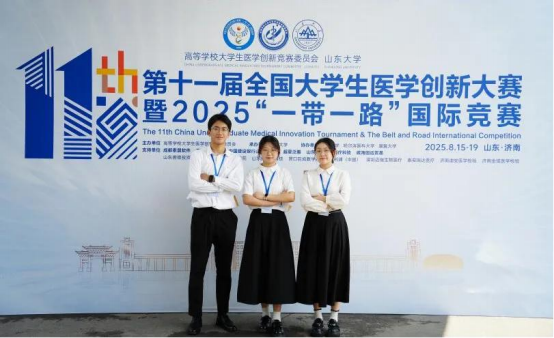

August16–18,Jinan— The11thNationalMedicalInnovationCompetitionforUniversity Students and the concurrent "Belt and Road" InternationalCompetition concluded successfully at Shandong University. Co-hosted by the National Medical Innovation Competition Committee for College Students, this year's finals featured unprecedented scale, drawing over 4,000 faculty and students from 20l universities across l0 countries—a vibrant showcase of global medical youth innovation and the fruits of medical education reform.
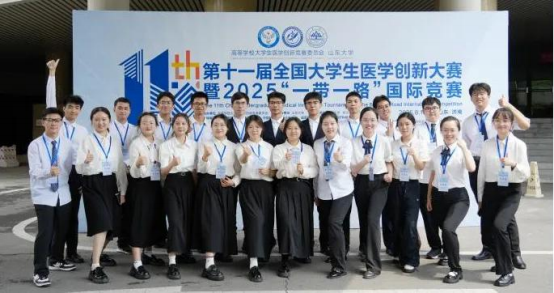
Jinan University students distinguished themselves through outstanding research innovation capabilities, solid professional foundations, and composed on-site performance, ultimately securing 2 Gold Awards, 2 Silver Awards, and 1 Best PresentationAward. Jinan University also received theOutstandingOrganization Award.

The National Medical Innovation Competition stands among China's most influential platforms for cultivating medical students' innovative spirit and practical capabilities. This remarkable achievement not only highlights the excellence of Jinan medical faculty and students but also demonstrates the University's significant progress in entrepreneurship and innovation education reform and the cultivation of outstanding medical professionals.
Gold Award Projects
1. Targeting Macrophage PKM2 for Ulcerative Colitis Treatment through Enhanced Intestinal Mucosal Repair Category: Basic Clinical Sciences — InnovativeResearchPrincipalInvestigator:Chen HaoxianTeamMembers:Ji Ziyi, Cui Yiming, Liu Junli, Zhao PeixinSupervisor:Professor Hong Jian
Incomplete mucosal healing represents a critical driver of ulcerative colitis (UC) progression and relapse, with macrophage metabolic reprogramming and phenotypic switching playing central roles. This project identifies macrophage PKM2 as a therapeutic target, demonstrating that its modulation induces reparative macrophage polarization, promotes intestinal stem cell regeneration, and restores epithelial barrier integrity—offering a novel clinical strategy for UC management.
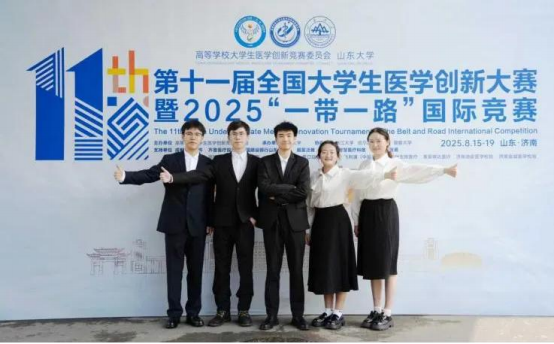
2.The MacrophagePKM2-SPP1 AxisinPromoting Biliary ReactioninPrimary Sclerosing Cholangitis Category: Basic Clinical Sciences — Innovative DesignPrincipalInvestigator:Bai Hao Team Members: Hu Bo, Lin Yuchen, Nie Su, Zhang GuochengSupervisor:Professor Hong Jian
Primary sclerosing cholangitis (PSC) is an autoimmune cholestatic liver disease characterized by biliary reaction, with high malignant transformation potential and complex pathogenesis lacking effective therapies. This project investigates macrophage PKM2 expression and function in PSC, elucidating the PKM2-SPP1 axis mechanism in regulating biliary reaction—providing novel theoretical insights into macrophage-mediated PSC progression.

Silver Award Projects
1.Mechanical Sensing byIntestinalL Cells Regulates Glycemic Control and Hepatic Lipid Metabolism via GLP-1 Category: Basic Clinical Sciences — InnovativeDesignPrincipalInvestigator:Wu Shaohong Team Members:Deng Handan, Liao Yuqi, Zhao Yuhang, Zang YufeiSupervisor:Professor Xu Geyang
This project addresses glucose regulation mechanisms in Type 2 diabetes, identifying intestinal L cell Piezo1 as a mechanosensor that perceives gut mechanical stimulation, activates the CaMKKβ/CaMKIV-mTORC1 signaling cascade, and enhances GLP- 1 secretion to maintain glycemic homeostasis—establishing new mechanistic insights and potential therapeutic targets for Type 2 diabetes intervention.

2. SYK-Driven Actin Cytoskeleton Remodeling in Cholangiocarcinoma Metastasis and Targeted Intervention Category: Basic Clinical Sciences — Innovative Research Principal Investigator: Luo Xiaoyu Team Members: Liu
Lihao, Gao YiyangSupervisor:Professor Yao Nan
This project reveals that the immune regulatory kinase SYK promotes cholangiocarcinoma metastasis through cofilin phosphorylation-mediated actin cytoskeleton remodeling. Building upon this mechanistic understanding, the team engineered a cholesterol-conjugated heteroduplex oligonucleotide (HDO) that exploits the cancer cells' high cholesterol uptake as a metabolic vulnerability—transforming the cancer's own metabolic weakness into a therapeutic weapon and offering innovative targeted treatment strategies for cholangiocarcinoma.