
Publication Information
Title: A Microbiota- and IL-15-Dependent Innate-Like B Cell Progenitor Expressing E4BP4
Author(s):He, Junming Hou, Xinlei Feng, Xiaomei Dong, Yayun Ren, Mengqi Deng, Surong Yang, Xinru Chen, Donglin Zhao, Lingna Chen, Shasha Yang, Meixiang Dong, Zhongjun
Journal Name:Year,Volume(Issue): Page range:
Advanced Science:2026, 13(18)
DOI:10.1002/advs.202512444
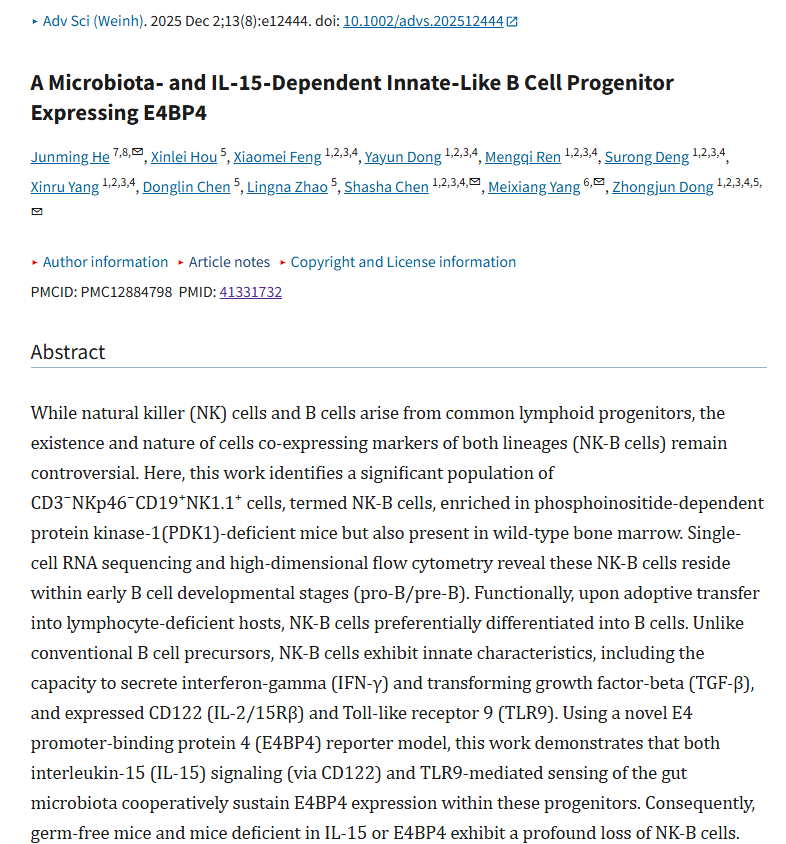
Abstract:While natural killer (NK) cells and B cells arise from common lymphoid progenitors, the existence and nature of cells co-expressing markers of both lineages (NK-B cells) remain controversial. Here, this work identifies a significant population of CD3-NKp46-CD19⁺NK1.1⁺ cells, termed NK-B cells, enriched in phosphoinositide-dependent protein kinase-1(PDK1)-deficient mice but also present in wild-type bone marrow. Single-cell RNA sequencing and high-dimensional flow cytometry reveal these NK-B cells reside within early B cell developmental stages (pro-B/pre-B). Functionally, upon adoptive transfer into lymphocyte-deficient hosts, NK-B cells preferentially differentiated into B cells. Unlike conventional B cell precursors, NK-B cells exhibit innate characteristics, including the capacity to secrete interferon-gamma (IFN-γ) and transforming growth factor-beta (TGF-β), and expressed CD122 (IL-2/15Rβ) and Toll-like receptor 9 (TLR9). Using a novel E4 promoter-binding protein 4 (E4BP4) reporter model, this work demonstrates that both interleukin-15 (IL-15) signaling (via CD122) and TLR9-mediated sensing of the gut microbiota cooperatively sustain E4BP4 expression within these progenitors. Consequently, germ-free mice and mice deficient in IL-15 or E4BP4 exhibit a profound loss of NK-B cells. These findings unveil a distinct E4BP4-expressing, innate-like B cell progenitor pathway regulated by microbiota and IL-15.
First Page of Article: