

Title:The team of Professor XU Geyang from the School of Basic Medicine and Public Health has made a series of important advancements in the field of mechanosensation and glycolipid metabolism, with related work published in journals such asNature Metabolism,Science Advances, andAdvanced Science.
Mechanical force is increasingly recognized as a core regulator of cellular and tissue function, acting in concert with biochemical signals to orchestrate development, homeostasis, and disease progression. Various organs in the human body—from the beating heart and expanding lung, to the blood vessel walls subjected to shear stress and the weight-bearing joints—are constantly exposed to complex mechanical stimuli. These mechanical forces are not passive byproducts but are actively sensed by cells and converted into biochemical signals, a process known as mechanotransduction. Breakthroughs in this field were honored with the 2021 Nobel Prize in Physiology or Medicine, awarded to David Julius and Ardem Patapoutian for their discovery of temperature and touch receptors. Notably, the team of David Julius identified and cloned the Piezo1 and Piezo2 channels, which directly respond to mechanical forces such as membrane stretch, shear stress, and pressure, establishing them as key mechanosensors. This discovery has clearly elucidated the molecular basis of mechanosensation in touch, proprioception, blood pressure regulation, bladder sensing, and even bone and vascular development, laying a critical foundation for research in this field.
The gastrointestinal (GI) tract is one of the most representative mechanosensory organs in the human body, and its normal digestive function highly depends on a complex mechanical environment. From the initiation of food intake, the shear forces generated by chewing, the distension of the pharynx and esophagus by food boluses, the tension and pressure on the stomach wall during gastric filling, to the mixing and propulsive forces generated during intestinal peristalsis—these forces collectively form a dynamic and multilayered network of mechanical stimuli within the digestive organs. These mechanical forces are not merely natural consequences of digestive movements but are also key signals regulating digestive function.
The team of Professor XU Geyang at our school has long been dedicated to research in digestive endocrinology and energy metabolism. In recent years, they have conducted systematic investigations into the mechanisms linking mechanosensation in digestive organs to glycolipid metabolism, achieving a series of research accomplishments:
I. In-depth elucidation of the mechanism underlying gastric satiety formation and its key role in postprandial hepatic lipid metabolism
During gastric distension, the precise molecular mechanisms by which mucosal epithelial cells sense mechanical stretch and compression had remained largely unclear. Professor Xu Geyang's team systematically discovered that the Piezo1 channel on ghrelin cells acts as a mechanical switch regulating food intake, revealing for the first time a novel appetite-regulating pathway: "gastric stretch → Piezo1 activation → inhibition of ghrelin secretion → reduced food intake." This finding not only deepens our understanding of the fundamental physiological mechanisms regulating appetite but also offers a new therapeutic direction targeting Piezo1 for obesity intervention (related findings published in Nature Metabolism, 2024; Professor Xu Geyang is the last corresponding author). This achievement was selected as an "Editors' Choice" by Science Signaling, and Associate Editor Dr. Wei Wong specifically wrote a featured article titled "Sensing stretch to suppress appetite," highly affirming the academic value of this research (Wong W. Science Signaling, 2024, 17(831): eadp6031). Additionally, this study was selected as one of the "Top 10 Research Advances in Biomechanics and Mechanobiology in China 2024" by the journal Mechanobiology in Medicine.
Furthermore, Professor Xu Geyang's team also discovered that "gastric satiety can prevent the development of fatty liver." This finding provides direct experimental evidence for the regulatory role of the "stomach-liver axis" in hepatic lipid metabolism and offers new ideas and strategies for the prevention and treatment of Metabolic Dysfunction-Associated Steatotic Liver Disease (MASLD). The related paper was published in Science Signaling (2024; Professor Xu Geyang is the last corresponding author; PMID: 39436995; journal online cover article). Associate Editor Dr. Wei Wong noted in a commentary: "Given that MASLD has become the most common liver disease worldwide, the Piezo1 protein in gastric ghrelin cells holds promise as a potential therapeutic target, providing a new direction for clinical intervention of this disease."
II. Systematic elucidation of the critical role of intestinal mechanosensation in regulating glycolipid homeostasis
In recent years, glucagon-like peptide-1 (GLP-1) secreted by intestinal L cells has garnered widespread attention from the global scientific and clinical communities due to its unique efficacy in lowering blood glucose and reducing body weight. Intestinal L cells that secrete GLP-1 are typical "open-type" endocrine cells. How open-type cells receive mechanical stimuli has long been an unresolved mystery in the field. Professor Xu Geyang's team revealed the core mechanism through in-depth research: after a meal, mechanical stretch and compression exerted by intestinal contents on mucosal L cells activate the mechanosensitive molecule Piezo1 on the L cell surface, triggering GLP-1 secretion, thereby playing a key regulatory role in postprandial blood glucose homeostasis. Impairment of the Piezo1 mechanosensitive mechanism in L cells leads to deficient GLP-1 synthesis and secretion, subsequently increasing the risk of diabetes (related research published in eLife, 2024; Professor Xu Geyang is the last corresponding author; PMID: 39509292). Endocrinologist Professor Jonathan S. Bogan from Yale University, serving as the Reviewing Editor for eLife, highly praised the scientific value and contribution of this work, stating that it is "innovative and is considered valuable, as the hypothesis that is being tested may have significant mechanistic and translational implications."
Further research by the team revealed that mice with L cell-specific Piezo1 knockout exhibit hyperactive hepatic lipid synthesis and are more susceptible to MASLD under high-fat diet feeding. This phenomenon is closely associated with impaired GLP-1 synthesis and secretion resulting from the loss of mechanosensory function in L cells. Notably, mechanical stretch generated by implanting silicone beads into the intestine effectively promotes GLP-1 secretion, thereby inhibiting de novo lipogenesis in hepatocytes—i.e., the "intestinal fullness" effect can improve hepatic lipid homeostasis. This discovery provides direct experimental evidence for the "gut-liver axis" in regulating hepatic lipid metabolism, suggesting that intestinal mechanical stretch can ameliorate the pathological state of fatty liver by promoting GLP-1 release from L cells. Related findings were published in Science Advances (2025; Professor Xu Geyang is the sole corresponding author; PMID: 40446026).
III. Mechanical intervention targeting intestinal epithelial cells: Achieving weight loss by inhibiting nutrient absorption
The mechanical stretch generated when chyme enters the intestine also has significant physiological implications, but whether it affects nutrient absorption had not been conclusively determined previously. Professor Xu Geyang's team found that lipid accumulation occurs in the duodenum of obese patients, with abnormally elevated expression of sugar and lipid absorption-related proteins (SGLT1, DGAT2) in their intestinal epithelial cells, while the expression of the mechanosensitive channel Piezo1 is significantly reduced. Animal experiments further confirmed that mice with intestinal epithelial-specific Piezo1 knockout exhibit hyperabsorption of sugar and lipids, and are more prone to dyslipidemia, hepatointestinal lipid accumulation, and obesity after high-fat diet feeding. Conversely, activating Piezo1 effectively inhibits glucose and fatty acid absorption via the CaMKK2-AMPK-SGLT1/DGAT2 signaling pathway. This study demonstrates that under physiological conditions, duodenal Piezo1 senses the mechanical stretch signal from chyme, thereby inhibiting sugar and lipid absorption; impairment of this regulatory mechanism leads to nutrient hyperabsorption and ultimately promotes obesity. This research not only provides a new perspective on the pathogenesis of obesity but also establishes a solid theoretical foundation for developing "intestinal mechanical intervention for glycemic and lipid reduction" strategies. The related paper was published in Acta Pharmaceutica Sinica B (2024; Professor Xu Geyang is the last corresponding author; PMID: 39220873).
IV. Hepatocyte Piezo1 regulates hepatic glycolipid homeostasis by sensing cell membrane tension
The liver, as a crucial metabolic hub, governs the regulation of carbohydrate, fat, and protein metabolism. In collaborative research with Professor Zhang Qi and Professor Chen Hui from Sun Yat-sen University, Professor Xu Geyang's team discovered that deletion of Piezo1 in hepatocytes leads to impaired cell membrane tension sensing, subsequently inducing hepatic lipid accumulation. The related research paper has been published in Advanced Science (2026; PMID: 41933941; Professor Xu Geyang is a co-corresponding author). Another study showed that hepatocyte Piezo1 deficiency results in decreased secretion of fibroblast growth factor 21 (FGF21), leading to enhanced glycogenolysis and elevated blood glucose levels; this paper was published in Cellular and Molecular Life Sciences (2025; Professor Xu Geyang is the last corresponding author; PMID: 41231251).
The above series of studies systematically reveal the multi-level regulatory roles of the Piezo1 mechanosensitive channel in glycolipid metabolism within digestive organs such as the stomach, intestine, and liver. They provide new perspectives for understanding the interrelationship between mechanosensation and energy metabolism and establish a solid theoretical foundation for mechanical medicine-based intervention strategies against metabolic diseases including obesity, diabetes, and fatty liver.
This series of research received strong support from experts including Dr. Chen Hui (Associate Researcher, The Third Affiliated Hospital of Sun Yat-sen University), Professor Zhang Weizhen (Peking University), Associate Professor Yang Jie (Guangzhou Medical University), Professor Wang Cunchuan (Jinan University), Associate Professor Lin Song (Jinan University), Dr. Zhai Hening (Jinan University), and Assistant Professor Guo Jinghui (School of Medicine, The Chinese University of Hong Kong, Shenzhen). Graduate students Zhao Yawen, Gao Luyang, Tao Tian, Zhang Jinshan, Huang Yanling, Guo Wenying, Yang Ke, and undergraduate student Mo Haocong served as the sole first authors or co-first authors of the respective papers. The research was funded by the National Natural Science Foundation of China (Grant Nos. 82570987, 82170818, 81770794) and other projects.
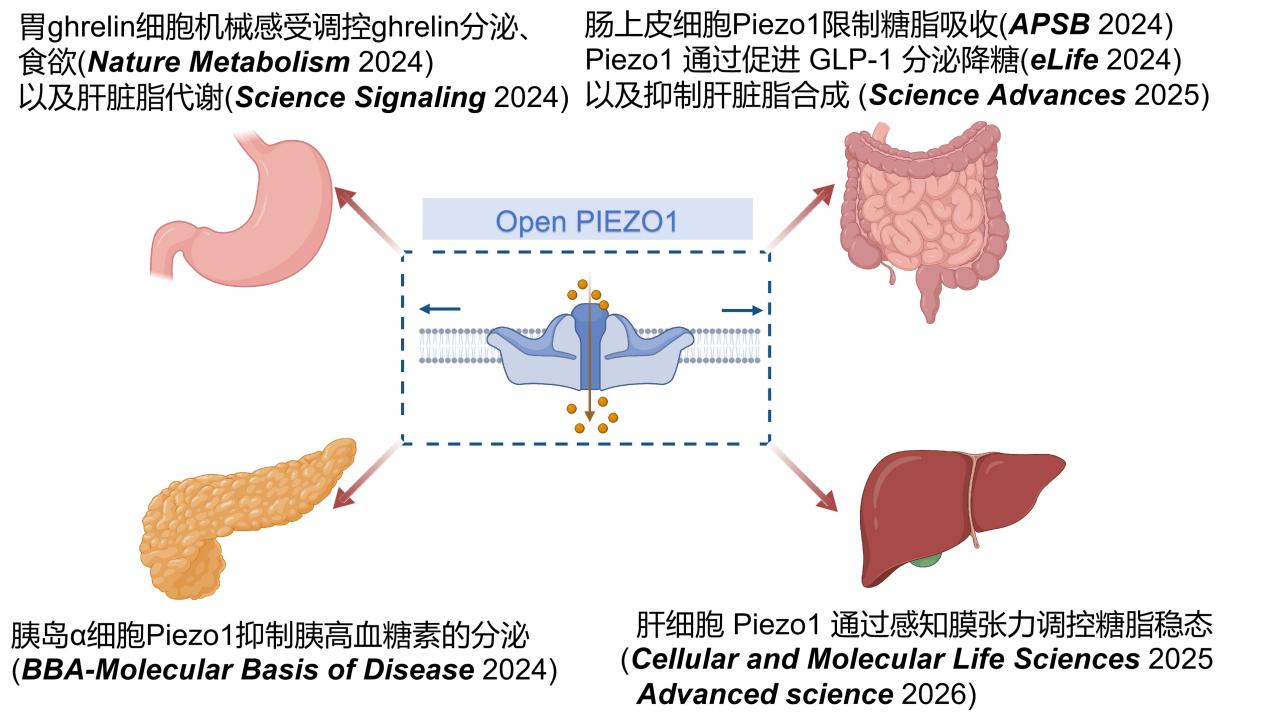 Mechanosensory Mechanisms of Digestive Organs and Energy Homeostasis
Mechanosensitive ion channel Piezo1 in digestive organs regulates the synthesis and secretion of metabolic hormones such as ghrelin, GLP-1, glucagon, and FGF21, as well as nutrient absorption in intestinal epithelial cells, ultimately influencing appetite and glycolipid homeostasis (2024-2026; related research findings have been published in authoritative journals including Nature Metabolism, eLife, Science Advances, Advanced Science, Acta Pharmaceutica Sinica B, Science Signaling, Cellular and Molecular Life Sciences, and Biochimica et Biophysica Acta).
